
In the middle of a playoff push, the Panthers are finally starting to click. At 8-8 entering the final game, there’s real momentum building and a legitimate chance this team finds its way into the postseason. But moments like this also make it impossible not to look back. You start thinking about the misses along the way. The decisions that could have changed how this team arrived here and what the future might look like.
The 2023 NFL Draft: A Fork in the Road
Who they selected: Xavier Legette
Who they should have selected: Ladd McConkey
The state of the Panthers and why they drafted Legette
At the time of the 2023 NFL Draft, the Carolina Panthers were coming off a disappointing season and starting a complete rebuild. With rookie quarterback Bryce Young now the face of the franchise, the front office’s top priority was surrounding him with playmakers. During the year, the shadow of USC quarterback Caleb Williams loomed large. The team had just traded away their best wide receiver, D.J. Moore, and the number one overall pick to the Chicago Bears for Young. Overall, the offense lacked explosiveness, separation, and reliability. The defense, although talented, had no true identity. The coaching staff was a mess.
Too Many Voices, No Clear Vision
The year before, head coach Matt Rhule had a tenure with the Panthers of 11–27 over three seasons (2020–2022) before being fired after a 1–4 start in 2022. Interim coach Steve Wilks, a Charlotte native, led the team to a 6–6 finish with a shot at winning the division. They did not hire him permanently but instead brought in former Indianapolis coach Frank Reich, who was fired in the middle of the next season with a 1–11 record. During his tenure, the offense struggled, and play-calling was inconsistent. Both Reich and offensive coordinator Thomas Brown rotated play-calling duties, but the two came from different coaching trees. Brown was with the Rams under Sean McVay, a motion and outside zone scheme, while Reich favored a vertical gap scheme. The two systems were blended poorly, and it did not work, making Bryce Young’s rookie year difficult.
Watching the Other Side of the Coin
The icing on the cake for their issues came in the form of C.J. Stroud’s rookie year, the number two pick in that draft. He played well, earning Offensive Rookie of the Year. Stroud finished top 10 in passing yards (4,108) and quarterback rating (100.8), and top 15 in touchdowns (23) and completions (319).
Betting on Traits, Size, and Upside
This draft was huge because Bryce Young needed to show improvement and produce on the field. The capital given up made this selection even more pivotal, as there were not a lot of options available or room for error. During that year, Xavier Legette, coming off a breakout senior season at South Carolina, looked like the perfect combination of athleticism, heart, and raw ability. A late bloomer who fought through adversity, Legette brought size (6’3″, 225 lbs), physicality, and yards-after-catch potential. He received comparisons to D.K. Metcalf, which caught scouts’ eyes. As a Carolina native, he had hometown appeal that the organization was eager to market, capturing local fans’ hearts.
The pick made sense at the time. The Panthers were betting on upside. At the bottom of the first round, Legette flashed big-play potential in the SEC, and his work ethic was praised by coaches. His game relied on natural ability and required development to refine what he could already do well. When Dave Canales spoke of Legette, it was with glowing admiration for his potential alongside Bryce Young. The idea was simple: pair Bryce Young with a dynamic, athletic wide receiver and let them grow together.
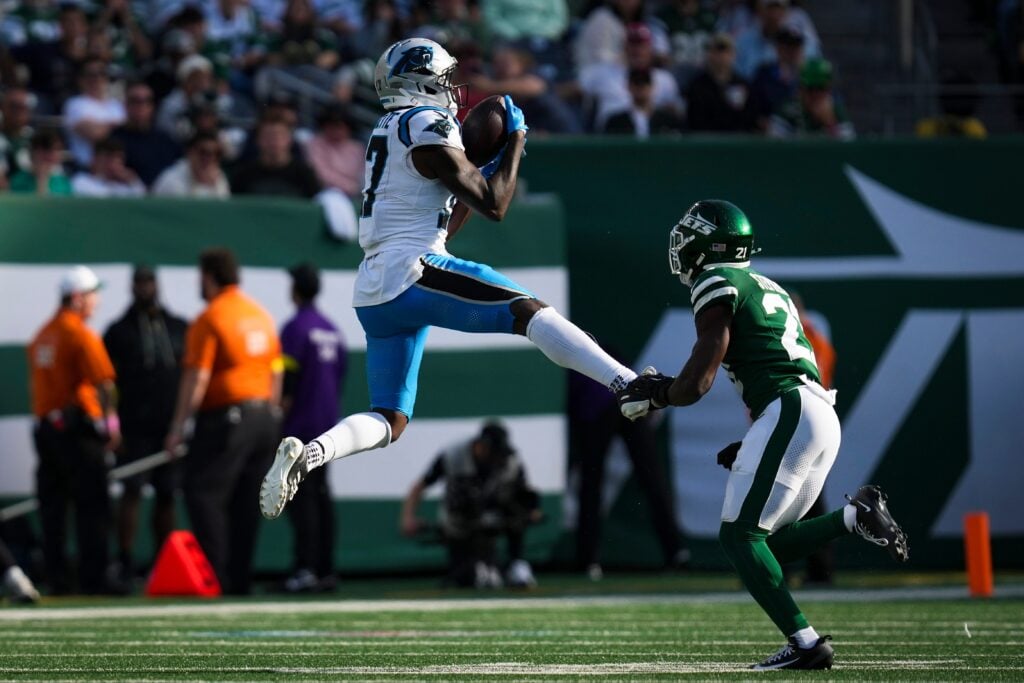
The Answer Was a Few Picks Away
Funny thing about the draft is that the answer could be found a few picks away. That answer was Ladd McConkey, selected by the Chargers in the second round, who was better from the start. What makes McConkey so effective is the precision, separation, and reliability of his routes. Bryce Young thrived in college with timing and anticipation, which made McConkey a better fit than Stroud in some ways. While Legette’s game is based on chemistry and playmaking, McConkey was NFL-ready from day one.
What could have been
Bryce Young’s game is a timing and rhythm game. He excels in quick reads and movement in the pocket. McConkey would have been an ideal fit. His crisp route running, ability to find space in zone coverage, and knack for creating instant separation would have immediately given Young a trusted go-to target. Chargers quarterback Justin Herbert praised McConkey multiple times during his rookie year. After the Chargers-Vikings game, Herbert told reporters that the rookie “picks up the offense quickly and plays like a four- or five-year vet.” He also highlighted McConkey’s speed, route running, and clutch play — all signs of developing chemistry.
Instead, the Panthers had Legette’s rookie campaign, which was marked by inconsistency and growing pains. If the Panthers had chosen McConkey, Bryce Young might have had the early comfort and consistency needed to build confidence. Instead, Carolina’s 29th-ranked offense continued to sputter, searching for rhythm and identity.
Why This Lesson Matters
While Legette has made an impact off the field, he is becoming a fan favorite and internet personality thanks to his humor and charisma. He even had an appearance in Glorilla’s “Typa” music video. However, his on-field production lagged behind expectations. He’s been fun to watch as a personality, but the Panthers need production.
The Panthers’ decision to draft Xavier Legette was a classic case of falling for traits over fit. Legette’s physical upside was undeniable, but the team overlooked how raw he was in the areas Bryce Young needed most: separation, precision, and reliability. They forgot what Bryce needed as a smaller quarterback whose traits are not world-breaking.
The front office seemed to learn from that mistake a year later. In the 2024 NFL Draft, the Panthers selected Tetairoa McMillan out of Arizona. A polished, versatile receiver, McMillan blended the best of both worlds. He possessed Legette’s size (6’5″) and athletic frame, but paired it with the technical refinement and football IQ that McConkey had shown. His tape stood out immediately. He consistently won at the catch point, understood spacing in zone coverage, and could adjust mid-route to his quarterback’s movement — something Legette struggled with as a rookie. Coaches and executives acknowledged post-draft that they wanted a player who could help Bryce Young now, not just in three years. McMillan’s selection was a direct correction, showing the Panthers learned that they needed technicians, not just athletes. Jalen Coker, the second-year receiver, has been coming along as well as the solution to fit what the Panthers thought they would have with Legette.
Final thoughts and hope
At the end of the day, Xavier Legette remains one of the most likable players on the roster. His personality, humility, and energy have brought attention to a team that struggled for relevance since the Cam Newton era.
Head coach Canales clearly values him. During the game against the Dolphins, Legette made two big catches to help the Panthers come back and win. Afterwards, in the press conference, Canales became emotional when speaking about Legette, stating, “He sees what he does on a weekly basis to attack what he needs to do better.” That is a player who earns respect from his teammates through his effort and dedication.
As a Panthers fan, I want him to succeed. I am glad McMillan is thriving because it gives the offense a fighting chance. I hope that this isn’t the end for Legette and that he one day becomes the player we all think he can be.