
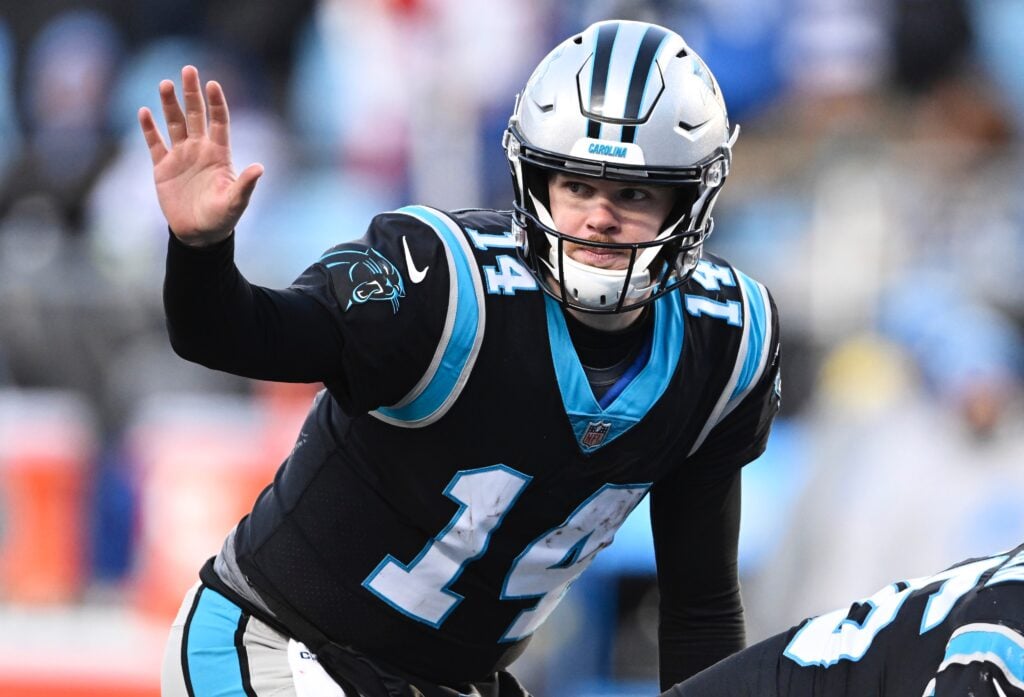
Sam Darnold’s career should make the Carolina Panthers uncomfortable.
Not because Darnold failed in Carolina, that part is already well documented, but because of what happened after. Once labeled a bust, Darnold rebuilt his career with functional organizations. He was bad with the New York Jets, struggled with consistency in Carolina, and eventually had to settle for a backup role in San Francisco. There, he waited for his turn under Kyle Shanahan, played in 10 games, and was part of a Super Bowl roster.
Although he didn’t win a championship with the 49ers, that experience gave him a clear picture of what success in the NFL actually looks like. He followed that with a breakout season in Minnesota and is now the starting quarterback for the NFC representative Seattle Seahawks.
Sam Darnold’s Career Is a Warning Sign for the Carolina Panthers and Bryce Young
Sam Darnold will be making his first Super Bowl start while playing for his fifth different team since entering the league. That’s the most teams a quarterback has played for before making his first Super Bowl start since Chris Chandler in the 1998 season. Chandler was with the Atlanta Falcons, his sixth team that year. This is not a common NFL story, and that’s exactly why it matters.
Darnold Didn’t Magically Become Talented Overnight
Darnold was the No. 3 overall pick in the 2018 NFL Draft for a reason. Arm talent. Mobility. Creativity. NFL traits were never the issue. What was missing in New York and Carolina was stability, both structurally and philosophically.
With the Jets, Darnold was thrown into a dysfunctional offense under Todd Bowles and Adam Gase. He played behind a weak offensive line with poor schematic support. In Carolina, the situation wasn’t much better. Matt Rhule was fired during Darnold’s second season. The Panthers turned to interim head coach Steve Wilks, failed to make the playoffs, and continued operating as a roster in transition.
There was no clear offensive identity. And as the saying goes, if you have two quarterbacks, you really have none. Both Darnold and Baker Mayfield were trying to survive in the same broken environment. Pure chaos.
When quarterbacks fail in two places, the league usually stops asking questions and moves on. But Darnold didn’t suddenly improve because he “figured it out” on his own. He improved because he finally entered organizations that knew how to develop quarterbacks.
San Francisco simplified the game.
Minnesota tailored the offense to his strengths.
Seattle trusted the structure around him.
The results followed.
Why This Is So Rare
Quarterbacks who struggle for five or six years rarely get another real shot. Teams now expect immediate returns because rookie contracts are cheap and the pressure to win is constant. Development has become a luxury instead of a priority.
That’s why Darnold’s resurgence is surprising, not because players can’t improve, but because most never get the chance to do so in the right environment.
The league is full of cautionary tales: Geno Smith, Baker Mayfield, Steve Young, Jim Plunkett. Talented players written off early, revived later by competent organizations. The common thread isn’t age or experience. Its structure.
The Lesson Carolina Must Learn for Bryce Young
This is where Bryce Young enters the conversation.
Young is younger, smaller, and less physically gifted than Darnold, but arguably more advanced mentally, coming out of college. Yet the early narrative around him has followed a familiar path: struggles, doubt, whispers of “bust.”
Sound familiar?
Young was drafted into an offense without protection, without weapons, and without continuity. Coaching changes. Scheme changes. Roster instability. He has been asked to survive rather than develop.
If the Panthers look at Sam Darnold’s tenure in Carolina and conclude, “He just wasn’t good enough,” they will miss the point entirely.
The real lesson is this: bad organizations can ruin good quarterbacks — and good organizations can resurrect them.
Development Is a Choice
The Panthers now face a decision they didn’t make correctly before.
Fortunately for Carolina, the Bryce Young era has already included a playoff berth. There are meaningful wins on the résumé, and the organization understands that Young needs support. But they also need to understand that Bryce Young is still a young quarterback.
Their moves this offseason must reflect that reality.
They need to build an offense around Bryce Young’s strengths, simplify his reads, protect him, and commit to continuity. They cannot afford to rush the evaluation or chase short-term fixes — or they risk repeating the same mistake.
Sam Darnold is proof that quarterback careers aren’t linear, but they are fragile. Development doesn’t happen by accident. It happens when organizations are patient, intentional, and competent.
Carolina has already watched one quarterback leave and succeed elsewhere.
They don’t get many more chances to learn that lesson.